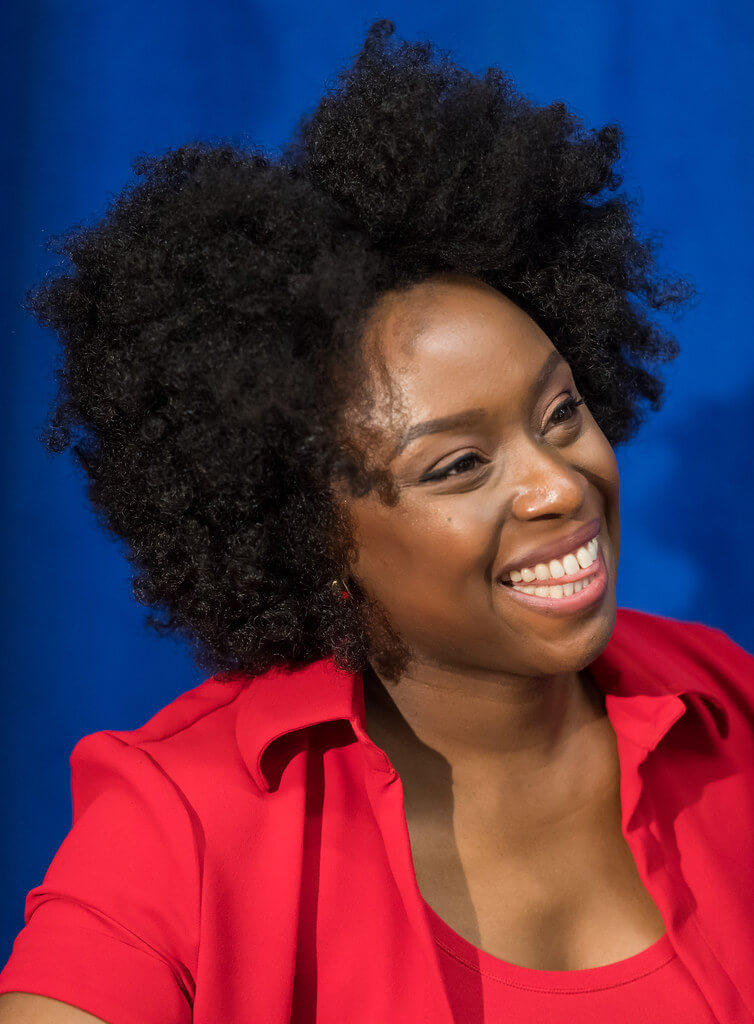
Chimamanda Adichie
We had the chance to interview Chimamanda Ngozi Adichie on the power of storytelling for civil society organisations and the role of narratives. Chimamanda Ngozi Adichie's literary career took off with the publication of Purple Hibiscus in 2003. In 2013, Americanah was published, the story of a young Nigerian woman who emigrates to the United States and faces poverty, discrimination and racism. In 2014, Chimamanda Ngozi Adichie published We should all be feminists, and in 2017, Dear Ijeawele or A Manifesto for a Feminist Education, two essays in which she advocates a feminist education that should be given from the earliest age. In the wake of this, she was elected to the American Academy of Arts and Sciences, one of the highest intellectual honours in the United States, and Fortune Magazine named her one of the 50 leaders of the world. Chimamanda Ngozi Adichie warns against the danger and fragility of a single story. The idea is that a dominant narrative about a country, a people or a group surreptitiously acquires the status of a single truth. This single truth is fragile because it is terribly reductive. These single narratives are fed by stereotypes (Africans are poor) and if we are not careful, they end up putting blinders on us. These themes she discussed at UCL where she was received the16th Honorary PhD. Pic: Suzanne Plunkett & Geoffrey Baker ©Howard County Library System